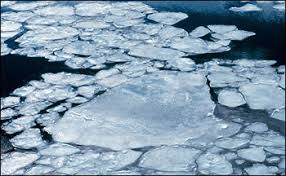
 The Arctic could lose virtually all its summer sea ice by the year 2040 – 40 years earlier than previously thought – according to a study by leading climate scientists. A rapid acceleration in the loss of sea ice seen in recent years will be dwarfed by the massive melting, up to four times faster than previously, which could take place within 20 years, the scientists predict.
If nothing is done to curb man-made emissions of greenhouse gases the Arctic Basin, from Siberia and Greenland to Canada and Alaska, could be open water in summer within the lifetime of today’s children.
The findings, part of the fourth assessment of the International Panel on Climate Change (IPCC) due next year, are published today in the journal Geophysical Research Letters.
Marika Holland of the National Centre of Atmospheric Research in Boulder, Colorado, the report’s lead author, said: “We have already witnessed major losses in sea ice, but our research suggests that the decrease over the next few decades could be far more dramatic.
An ice-free Arctic would almost certainly lead to the demise of many indigenous people and their way of life, along with the extinction of the polar bear and other species that rely on the year-long sea ice for survival.
The loss of sea ice could also lead to more serious long-term climate change, such as the disruption of the North Atlantic current that brings mild winters to Britain, or a more rapid loss of the Greenland ice sheet.
Their forecast may, however, already be out of date and over-optimistic, argues Professor Chris Rapley, head of the British Antarctic Survey.
He said a recent study by the Global Carbon Project suggested that emissions were rising more than twice as fast as in 2000, which was likely to speed up ice-loss even further.
“The study may be an underestimate of when the Arctic summer ice might be all gone,” he said. “It could well be their assumptions are more optimistic than they might be.”
The Arctic could lose virtually all its summer sea ice by the year 2040 – 40 years earlier than previously thought – according to a study by leading climate scientists.
A rapid acceleration in the loss of sea ice seen in recent years will be dwarfed by the massive melting, up to four times faster than previously, which could take place within 20 years, the scientists predict.
If nothing is done to curb man-made emissions of greenhouse gases the Arctic Basin, from Siberia and Greenland to Canada and Alaska, could be open water in summer within the lifetime of today’s children.
The findings, part of the fourth assessment of the International Panel on Climate Change (IPCC) due next year, are published today in the journal Geophysical Research Letters.
Previous climate models of the sea ice in the Arctic have suggested that the earliest date for a completely ice-free summer would be around 2080. An ice-free Arctic would almost certainly lead to the demise of many indigenous people and their way of life, along with the extinction of the polar bear and other species that rely on the year-long sea ice for survival.
The loss of sea ice could also lead to more serious long-term climate change, such as the disruption of the North Atlantic current that brings mild winters to Britain, or a more rapid loss of the Greenland ice sheet.
The latest study analysed levels of sea ice in the Arctic basin and used powerful supercomputers to model future scenarios of how the summer melting period is likely to develop.
Marika Holland of the National Centre of Atmospheric Research in Boulder, Colorado, the report’s lead author, said: “We have already witnessed major losses in sea ice, but our research suggests that the decrease over the next few decades could be far more dramatic.
“As the ice retreats, the ocean transports more heat to the Arctic and the open water absorbs more sunlight, further accelerating the rate of warming.”
Jeff Ridley, a climate scientist at the Met Office’s Hadley Centre for Climate Change, said the prediction of an essentially ice-free Arctic by September 2040 was surprising given that other computer models have suggested that this is not likely to occur before 2080.
However, Cecilia Bitz, of the University of Washington in Seattle, the study’s co-author, said the latest assessment was based on a “moderate scenario” of future man-made emissions of carbon dioxide.
“Other models have unrealistically thick ice in their simulation of the present-day climate, so they tend to be less sensitive than ours,” Dr Bitz said.
Since satellite measurements began in 1978, the area of the Arctic covered by floating sea ice steadily fell until 2002. But in recent years the loss has accelerated, with a summer minimum recorded in September 2005 and a winter minimum in March 2006. Scientists estimate that an area of summer sea ice the size of Alaska has been lost over the past 28 years.